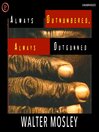
Always outnumbered, always outgunned

Walter Mosley

Book - 1998

Saved in:

1st Floor Show me where

FICTION/Mosley, Walter
1 / 1 copies available
Location Call Number   Status
1st Floor FICTION/Mosley, Walter Checked In
Subjects
Published
New York : W.W. Norton 1998.
Language
English
Main Author
Walter Mosley (-)
Physical Description
208 pages
ISBN
9780671014995
9780393045390
  • Always Outnumbered, Always Outgunned
  • Leadtext: Crimson Shadow: Section One "What you doin' there, boy?" It was six a.m
  • Socrates Fortlow had come out to the alley, to see what was wrong with Billy
  • He hadn't heard him crow that morning and was worried about his old friend
  • The sun was just coming up
  • The alley was almost pretty with the trash and broken asphalt covered in half-light
  • Discarded wine bottles shone like murky emeralds in the sludge
  • In the dawn shadows Socrates didn't even notice the boy until he moved
  • He was standing in front of a small cardboard box, across the alley -- next to Billy's wire fence
  • "What bidness is it to you, old man?" the boy answered
  • He couldn't have been more than twelve but he had that hard convict stare
  • Socrates knew convicts, knew them inside and out
  • "I asked you a question, boy
  • Ain't yo' momma told you t'be civil?" "Shit!" The boy turned away, ready to leave
  • He wore baggy jeans with a blooming blue T-shirt over his bony arms and chest
  • His hair was cut close to the scalp
  • The boy bent down to pick up the box
  • "What they call you?" Socrates asked the skinny butt stuck up in the air
  • "What's it to you?" Socrates pushed open the wooden fence and leapt
  • If the boy hadn't had his back turned he would have been able to dodge the stiff lunge
  • As it was he heard something and moved quickly to the side
  • Quickly
  • But not quickly enough
  • Socrates grabbed the skinny arms with his big hands -- the rock breakers, as Joe Benz used to call them
  • "Ow! Shit!" Socrates shook the boy until the serrated steak knife, which had appeared from nowhere, fell from his hand
  • The old brown rooster was dead in the box
  • His head slashed so badly that half of the beak was gone
  • "Let me loose, man." The boy kicked, but Socrates held him at arm's length
  • "Don't make me hurt you, boy," he warned
  • He let go of one arm and said, "Pick up that box
  • Pick it up!" When the boy obeyed, Socrates pulled him by the arm -- dragged him through the gate, past the tomato plants and string bean vines, into the two rooms where he'd stayed since they'd let him out of prison
  • The kitchen was only big enough for a man and a half
  • The floor was pitted linoleum; maroon where it had kept its color, gray where it had worn through
  • There was a card table for dining and a fold-up plastic chair for a seat
  • There was a sink with a hot plate on the drainboard and shelves that were once cabinets -- before the doors were torn off
  • The light fixture above the sink had a sixty-watt bulb burning in it
  • The room smelled of coffee
  • A newspaper was spread across the table
  • Socrates shoved the boy into the chair, not gently
  • "Sit'own!" There was a mass of webbing next to the weak lightbulb
  • A red spider picked its way slowly through the strands
  • "What's your name, boy?" Socrates asked again
  • "Darryl." There was a photograph of a painting tacked underneath the light
  • It was the image of a black woman in the doorway of a house
  • She wore a red dress and a red hat to protect her eyes from the sun
  • She had her arms crossed under her breasts and looked angry
  • Darryl stared at the painting while the spider danced above
  • "Why you kill my friend, asshole?" "What?" Darryl asked
  • There was fear in his voice
  • "You heard me." "I-I-I din't kill nobody." Darryl gulped and opened his eyes wider than seemed possible
  • "Who told you that?" When Socrates didn't say anything, Darryl jumped up to run, but the man socked him in the chest, knocking the wind out of him, pushing him back down in the chair
  • Socrates squatted down and scooped the rooster up out of the box
  • He held the limp old bird up in front of Darryl's face
  • "Why you kill Billy, boy?" "That's a bird." Darryl pointed
  • There was relief mixed with panic in his eyes
  • "That's my friend." "You crazy, old man
  • That's a bird
  • Bird cain't be nobody's friend." Darryl's words were still wild
  • Socrates knew the guilty look on his face
  • He wondered at the boy and at the rooster that had gotten him out of his bed every day for the past eight years
  • A rage went through him and he crushed the rooster's neck in his fist
  • "You crazy," Darryl said
  • A large truck made its way down the alley just then
  • The heavy vibrations went through the small kitchen, making plates and tinware rattle loudly
  • Socrates shoved the corpse into the boy's lap
  • "Get ovah there to the sink an' pluck it."
  • "Shit!" "You don't have to do it..."
  • "You better believe I ain't gonna..."
  • "...but I will kick holy shit outta you if you don't."
  • "Pluck what?
  • What you mean, pluck it?"
  • "I mean go ovah t'that sink an' pull out the feathers
  • What you kill it for if you ain't gonna pluck it?"
  • "I'as gonna sell it."
  • "Sell it?"
  • "Yeah," Darryl said
  • "Sell it to some old lady wanna make some chicken." Copyright (c) 1998 by Walter Mosley
Review by Booklist Review

In these interconnected short stories about an aging black man, Socrates Fortlow, living in a makeshift two-room apartment in an abandoned Watts building, Mosley turns on its head the fundamental fantasy of the detective story, the notion that a single individual can unlock a mystery whose solution will, temporarily, restore order to a chaotic world. Unlike Easy Rawlins, the hero of Mosley's own acclaimed detective series, Socrates lacks the wherewithal to solve mysteries, to move at least reasonably easily through various levels of society. Socrates is an ex-con, having served 27 years of hard time for a double murder. He lives precariously, delivering groceries and attempting to quell the demons that threaten to stir his "rock-breaking hands" to still more violence. And yet, despite all that, Socrates, too, restores temporary order in a chaotic world. His triumphs are small, attenuated things, but they are chiseled from the unyielding bedrock of despair that surrounds him: a few vials of morphine, acquired from a pusher, to ease the pain of his friend's prostate cancer; a momentary safe haven for a teenage boy, at risk from the local gangbangers. Every detective hero, even one as cut from real cloth as Easy Rawlins, is finally a fantasy figure, somebody with the answers we lack; Socrates Fortlow, "always outnumbered, always outgunned," is a fantasy-free hero. These are often difficult stories to read; never sentimental, they are finally, one and all, about pain and how we live with it. Perhaps that's why those brief moments when Socrates eases someone else's pain deliver such a powerful sense of catharsis. Hard-hitting, unrelenting, poignant short fiction. --Bill Ott

From Booklist, Copyright (c) American Library Association. Used with permission.
Review by Publisher's Weekly Review

Unveiling a new, bigger-than-life urban hero and a new series set in an updated version of Easy Rawlins's South Central Los Angeles, Mosley seems determined to confer on the mean streets of contemporary L.A. what filmmaker John Ford helped create for the American West: a gun-slinging mythology of street justice and a gritty, elegiac code of honor. Socrates Fortlow, an earthy ex-con with the stoic grandeur of an aging cowboy, who can "lift a forty-gallon trash can brimming with water and walk it a full city block," squats in a two-room apartment in Watts, tending a ramshackle garden and collecting bottles. Haunted by his 27 years in an Indiana prison and the murders he's committed with his own "rock-breaking hands," Socrates finds himself in a series of confrontations with a circle of friends and archetypal strangers (a thief, an adulterer and a Vietnam vet) with whom he frequently holds streetwise Platonic dialogues on ethics, remorse and retribution. He fraternizes with neighbors who, against the odds, have helped his community at the grass roots, like Right Burke, whose irascible wife maintains a rooming house for poor blacks, and Oscar Minette, who runs an independent bookstore. He teaches lessons about remorse and manhood to Daryl, a local teenager, finds a job bagging groceries in a more prosperous neighborhood and reluctantly helps the police catch a local arsonist. Fans of the intricately plotted Easy Rawlins novels may be surprised by the episodic format here, in which the linked stories are presented in short chapters with such didactic titles as "History" and "Double Standard" In creating such a maverick protagonist, Mosley has produced a not-quite novel that reads like a philosophical treatise, memorable less for any character insights or resolution than for its indelible vision of "poor men living on the edge of mayhem." BOMC and QPB selections. (Nov.) FYI: Mosley has written a screenplay for an HBO movie based on the novel. (c) Copyright PWxyz, LLC. All rights reserved

(c) Copyright PWxyz, LLC. All rights reserved
Review by Library Journal Review

Move over, Easy. Here comes Socrates Fortlow. Having once committed murder in a drunken rage and served his time, Socrates is more inclined to ask the big questions about life and death than to get tangled up in solving murders. Watch for the made-for-HBO movie. (c) Copyright 2010. Library Journals LLC, a wholly owned subsidiary of Media Source, Inc. No redistribution permitted.

(c) Copyright Library Journals LLC, a wholly owned subsidiary of Media Source, Inc. No redistribution permitted.
Review by Kirkus Book Review

Mosley takes a break from his peerless Easy Rawlins series (Gone Fishin', 1997, etc.) for a cycle of non-mystery stories set in the same violent neighborhood of Watts. Like Easy, Socrates Fortlow has lived a long time with the dark side of life and himself. Thirty-five years ago, Socrates, addled with drink and lust, raped and killed a pair of acquaintances. Now, eight years after his endless prison sentence, he's living in a two-room apartment little better than his cell, and he still watches his back, avoids the Man, and assigns himself a grade at the end of every day. ``Once you go to prison you belong there,'' he says of the brutalizing effect his term worked on him. But no matter how hard he tries, Socrates can't turn his back on life. A walk on the beach stirs memories and desires he'd rather not face; a tense face-off with a neighborhood adulterer awakens both his sharpest censure and his sharpest self-criticism. And he's not just a survivor; amid the allures of the flesh and the fear and anger he feels about being a black American, his life also lurches forward. He pushes the staff of the Bounty Supermarket to hire him as a grocery boxer; he takes in Darryl, a boy he can tell killed somebody else, too; he gets together with a WW II vet to expel a crack dealer from the neighborhood; he wrestles manfully with the question of whether he should rat a homicidal firebug out to the hated police. Whether he's remembering the bookstore intellectuals he used to hang around with or teaching Darryl to stand up to a gangbanger, Socrates constantly judges himself. As he writes to an old girlfriend: ``I don't get into trouble even when it's not my fault.'' The elemental recurrence of fear and lust and rage are right out of Easy Rawlins, even if Socrates' story exhibits rather than extends Mosley's range. (Author tour)

Copyright (c) Kirkus Reviews, used with permission.

Crimson Shadow: Section One "What you doin' there, boy?" It was six a.m. Socrates Fortlow had come out to the alley, to see what was wrong with Billy. He hadn't heard him crow that morning and was worried about his old friend. The sun was just coming up. The alley was almost pretty with the trash and broken asphalt covered in half-light. Discarded wine bottles shone like murky emeralds in the sludge. In the dawn shadows Socrates didn't even notice the boy until he moved. He was standing in front of a small cardboard box, across the alley -- next to Billy's wire fence. "What bidness is it to you, old man?" the boy answered. He couldn't have been more than twelve but he had that hard convict stare. Socrates knew convicts, knew them inside and out. "I asked you a question, boy. Ain't yo' momma told you t'be civil?" "Shit!" The boy turned away, ready to leave. He wore baggy jeans with a blooming blue T-shirt over his bony arms and chest. His hair was cut close to the scalp. The boy bent down to pick up the box. "What they call you?" Socrates asked the skinny butt stuck up in the air. "What's it to you?" Socrates pushed open the wooden fence and leapt. If the boy hadn't had his back turned he would have been able to dodge the stiff lunge. As it was he heard something and moved quickly to the side. Quickly. But not quickly enough. Socrates grabbed the skinny arms with his big hands -- the rock breakers, as Joe Benz used to call them. "Ow! Shit!" Socrates shook the boy until the serrated steak knife, which had appeared from nowhere, fell from his hand. The old brown rooster was dead in the box. His head slashed so badly that half of the beak was gone. "Let me loose, man." The boy kicked, but Socrates held him at arm's length. "Don't make me hurt you, boy," he warned. He let go of one arm and said, "Pick up that box. Pick it up!" When the boy obeyed, Socrates pulled him by the arm -- dragged him through the gate, past the tomato plants and string bean vines, into the two rooms where he'd stayed since they'd let him out of prison. The kitchen was only big enough for a man and a half. The floor was pitted linoleum; maroon where it had kept its color, gray where it had worn through. There was a card table for dining and a fold-up plastic chair for a seat. There was a sink with a hot plate on the drainboard and shelves that were once cabinets -- before the doors were torn off. The light fixture above the sink had a sixty-watt bulb burning in it. The room smelled of coffee. A newspaper was spread across the table. Socrates shoved the boy into the chair, not gently. "Sit'own!" There was a mass of webbing next to the weak lightbulb. A red spider picked its way slowly through the strands. "What's your name, boy?" Socrates asked again. "Darryl." There was a photograph of a painting tacked underneath the light. It was the image of a black woman in the doorway of a house. She wore a red dress and a red hat to protect her eyes from the sun. She had her arms crossed under her breasts and looked angry. Darryl stared at the painting while the spider danced above. "Why you kill my friend, asshole?" "What?" Darryl asked. There was fear in his voice. "You heard me." "I-I-I din't kill nobody." Darryl gulped and opened his eyes wider than seemed possible. "Who told you that?" When Socrates didn't say anything, Darryl jumped up to run, but the man socked him in the chest, knocking the wind out of him, pushing him back down in the chair. Socrates squatted down and scooped the rooster up out of the box. He held the limp old bird up in front of Darryl's face. "Why you kill Billy, boy?" "That's a bird." Darryl pointed. There was relief mixed with panic in his eyes. "That's my friend." "You crazy, old man. That's a bird. Bird cain't be nobody's friend." Darryl's words were still wild. Socrates knew the guilty look on his face. He wondered at the boy and at the rooster that had gotten him out of his bed every day for the past eight years. A rage went through him and he crushed the rooster's neck in his fist. "You crazy," Darryl said. A large truck made its way down the alley just then. The heavy vibrations went through the small kitchen, making plates and tinware rattle loudly. Socrates shoved the corpse into the boy's lap. "Get ovah there to the sink an' pluck it." "Shit!" "You don't have to do it..." "You better believe I ain't gonna..." "...but I will kick holy shit outta you if you don't." "Pluck what? What you mean, pluck it?" "I mean go ovah t'that sink an' pull out the feathers. What you kill it for if you ain't gonna pluck it?" "I'as gonna sell it." "Sell it?" "Yeah," Darryl said. "Sell it to some old lady wanna make some chicken." Copyright © 1998 by Walter Mosley Excerpted from Always Outnumbered, Always Outgunned by Walter Mosley All rights reserved by the original copyright owners. Excerpts are provided for display purposes only and may not be reproduced, reprinted or distributed without the written permission of the publisher.