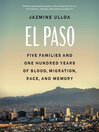
El Paso One hundred years of blood, race, and memory

Jazmine Ulloa

Book - 2026

"From New York Times reporter Jazmine Ulloa, a sweeping human history of El Paso, revealing violence, power, and privilege at play in America's most famous border town. El Paso has been called the "Ellis Island" of America's southern border, a mountain pass cum border town cum bifurcated metropolis where past meets future, and disadvantage meets opportunity, or so the promise goes. El Paso is an extraordinary, can't-look-away reported history; it uses deep research and dozens of new interviews to blow away the myth of this place, where Mexico's Juarez and America's El Paso intertwine. It charts the history of El Paso through five families. From the Mexican Revolution and the Mexican Repatriation, to t...he shifting immigration laws under Reagan and Trump and the violence and bloodshed brought on by the drug war, El Paso captures a place often misunderstood or forgotten by the rest of the country, and the world. El Paso is a brave new work of narrative nonfiction that gives new voice and perspective to history that has long been checked at the border, or told through the lens of white men alone. Ulloa draws upon meticulous research and reporting and stunning historical detail to craft the intimate narratives of an unforgettable cast of characters"--

Saved in:
1 copy ordered
Subjects
Published
New York : Dutton, an imprint of Penguin Random House LLC [2026]
Language
English
Main Author
Jazmine Ulloa (author)
Physical Description
pages cm
Bibliography
Includes bibliographical references and index.
ISBN
9780593471869
Contents unavailable.
Review by Library Journal Review

El Paso, TX, is one of the main border crossings from Mexico into the United States, but New York Times reporter Ulloa argues that it receives inadequate attention. Her book presents stories about five families connected to El Paso, spotlighting important events in the city's history and in that of its neighbor, Juarez, Mexico. These events include the Mexican Revolution, Pancho Villa's raids, the drug war, the bracero period, and the recent migration crisis. Immigration looms large in the narrative, as border-crossing restrictions tighten over the decades and migrants are forced into more desperate situations. Additionally, U.S. interference in Latin American politics has long contributed to instability, which in turn forces more migrants to travel north. Economic policy and racism play prominent roles in border policy, affecting the lives of the profiled families. Ulloa and her subjects also reflect on their multicultural identities and sense of belonging. Moreover, Ulloa tells the story of her own family and discusses the effects of the 2019 El Paso shooting, a hate crime against Latinos. VERDICT A fascinating exploration of two intertwined cities. Recommended for readers interested in Texan and Mexican history.--Rebekah Kati

(c) Copyright Library Journals LLC, a wholly owned subsidiary of Media Source, Inc. No redistribution permitted.
Review by Kirkus Book Review

Illuminating the history and identity of "the new Ellis Island." Ulloa, a national reporter for theNew York Times, recounts the turbulent history of Mexico, Latin America, and U.S. border states by following five families: the Chews, Martinezes, Holguins, Rubios, and Mura'ls. The author, who covered murders in Ciudad Juárez, Mexico, and a mass shooting in a Walmart in El Paso in 2019 (the tragic retellings of the horrific crimes are in this book), makes the case that El Paso deserves the historical spotlight. She succeeds with flying colors. Readers may sometimes find the detail-loaded narrative of this crossroads, gateway city difficult to follow, as the author jumps back and forth across generations and continents, overlapping and weaving through the families' trials, glories, historical figures, and tribulations. But the outpouring has a purpose: As much as we try to suppress, ignore, or compartmentalize history, it has a way of clawing its way back. We can't escape the traumas of our past, and if we don't face them head-on, as Ulloa does, they will return with an insidious force. In the ebbing and flowing narrative of immigration battles and families trying to find their place in the world, the author guides us, expertly, through history, politics, and personal stories, ending with her own family's origin story. She deftly employs Spanish terms throughout the book, from los hornos (outdoor ovens) to obreros (workers) to vagos (wild ones), which infuse the work with an authentic sense of place. El Paso, she writes, is a "backdrop to an immigration fight that at its crux, scholars say, is truly about the preservation of American democracy." A passionate and urgent account that transforms the embers of a bypassed history into flames that consume the present. Copyright (c) Kirkus Reviews, used with permission.

Copyright (c) Kirkus Reviews, used with permission.