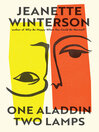
Review by Publisher's Weekly Review
Critic and fiction writer Winterson (Night Side of the River) anchors this dazzling memoir-in-essays in her childhood obsession with One Thousand and One Nights, the collection of Middle Eastern folktales that introduced magic lamps and flying carpets to the West. Casting herself as Aladdin, Winterson examines contemporary ills from climate change to doomscrolling--and more timeless concerns from misogyny to religion--in freewheeling essays that invite readers to take a closer look at the fabric of their daily lives. One minute, Winterson is proclaiming that social media's "weapons of mass distraction... shrink the human mind" and declaring phone addiction "a miserable way to live"; the next, she exalts fiction's power to illuminate "inner realities that gradually press forward into our outer circumstance." Faith in story eventually emerges as the book's main concern, with Winterson encouraging readers to apply a literary analyst's lens to the problems of today: "The present is often provisional," she writes. "We don't understand it till it's over." Though the concepts can be dense, Winterson's language is accessible and unfussy, and an irrepressible sense of play animates the project. By the time it's over, readers will feel like they're seeing the world around them through brand new eyes. Agent: Caroline Michel, Peters, Fraser and Dunlop. (Jan.)
(c) Copyright PWxyz, LLC. All rights reserved
Review by Library Journal Review
British novelist Winterson (Night Side of the River) reveals the conceit of her new book in the first few pages. After watching a Christmas pantomime of Aladdin, this adopted daughter of a factory worker found a copy of the Thousand and One Nights in her local library; it went on to frame her own storytelling life. She argues here that stories are continuous and changeable. Her observations draw on chance encounters, transformations, and inexplicable luck in both writing and reading her life story. Blending memoir, literary criticism, conversational narrative, and fiction, Winterson liberates herself from established literary forms and the traditional ideas of a culture dominated by men--just as Shahrazad liberated herself from the sultan's bondage. This is not a retelling of Nights; instead, it's a deconstruction of that woman-centric story cycle, from a contemporary queer novelist who chips away at the man-made, heteronormative contemporary world. The book spans diverse disciplines and decades, spinning a taut web of stories--of libraries, literature, life, and love--in a chasm as deep as one plumbed by Isabel Allende. VERDICT This is serious reading about reading and an essential title for any public or academic library collection.--Jeffrey Aubuchon
(c) Copyright Library Journals LLC, a wholly owned subsidiary of Media Source, Inc. No redistribution permitted.
Review by Kirkus Book Review
Telling tales. A prolific writer across a range of genres, Winterson examines the richness ofOne Thousand and One Nights to argue passionately for the power of imagination. Melding memoir, fiction, and cultural criticism, she pays homage to Shahrazad, consummate inventor of seductive tales, who enlightens her captor--and would-be executioner, the Sultan Shahryar--about the power of imagination. "Imagination is key," Winterson writes. "To see past the present, with its assumptions and constraints. To see round corners." Stories teach us about what it means to be human, including that being human "can mean appearing in other shapes and other forms." Stories, as the author discovered in her own life, give us permission to break out of ill-fitting strictures. Growing up lesbian, an only child and adoptee in an ultrareligious evangelical home, she felt that she was "simultaneously hiding a true self and finding a true self." In the library, she found liberation in fiction that gave her a chance to imagine "what it is like to be someone else" and to inhabit new worlds. "One of the things I love about fiction," she writes, "is that we can--and do--escape our fate. A word of caution here. This may not mean the characters in the story." Turning to Shahrazad's stories, Winterson notes that recurring themes are "harm done to those who are innocent" and "failure to recognise what is valuable, and what is worthless." What is worthless, according to her, is mind-numbing work and rampant consumerism, for which, she speculates, sentient AI may provide an escape, having no interest in material acquisitions: "The invisible, unfettered, unbounded, non-material life of the imagination, and what it invents,that is the basis of reality." An ardent defense of storytelling. Copyright (c) Kirkus Reviews, used with permission.
Copyright (c) Kirkus Reviews, used with permission.